
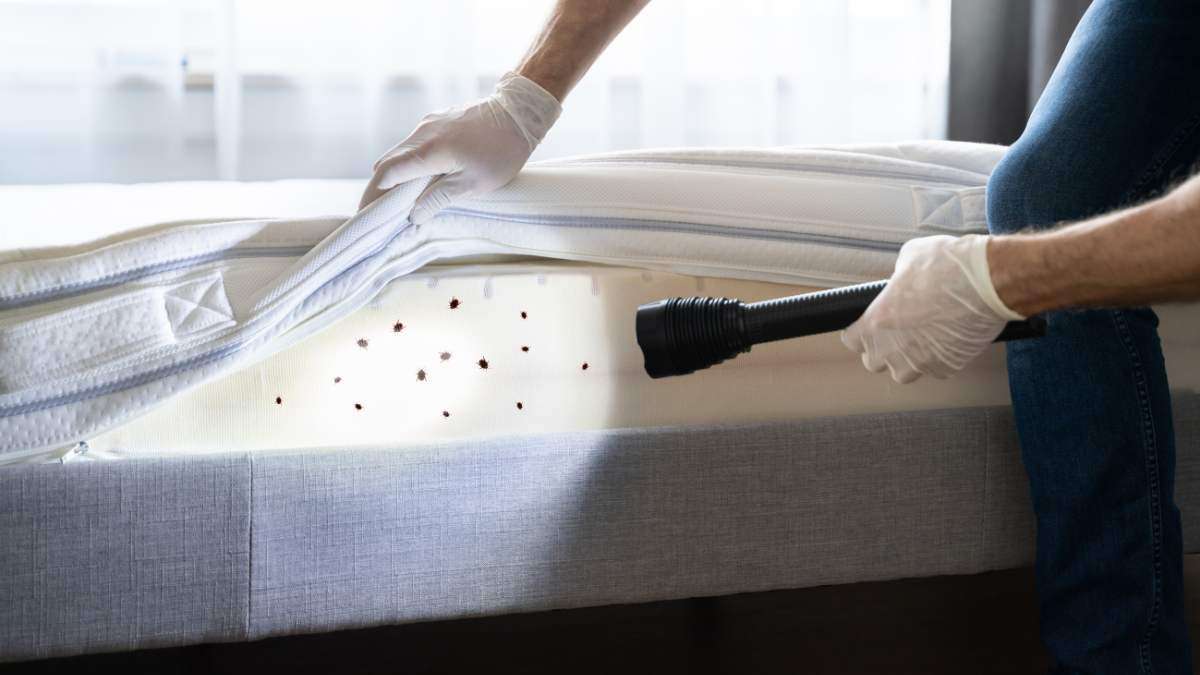
Bed bugs are annoying pests similar to fleas that feed on the blood of humans or animals. These small insects are found primarily in bedrooms, especially mattresses and bed frames.
Luckily, there are many ways to eliminate them from your home using natural, eco-friendly products.
What kills bed bugs fast? Here are six solutions to get rid of these intrusive insects fast and effectively:
- Diatomaceous Earth
- Heat
- Bed Bug Traps
- Rubbing Alcohol
- Vacuum Cleaner
- Mattress Encasements
This article does a deep dive into bed bugs, including why they’re in your home, answering questions like ‘does Lysol kill bed bugs?’ and taking a look at the difference between a bed bug vs. roach vs. other pests. Most importantly, I’ll discuss what kills bed bugs fast!
Bed Bug Basics: Why They’re In Your Home

To figure out what kills bed bugs fast, it’s important to first learn why these pests are in your home. Bed bugs are common pests found in homes, hotels, apartment buildings, and even on public transportation. These tiny pests can be found anywhere that humans are. The reason? They feed on blood.
Like fleas, bed bugs must feed on blood to lay eggs. However, the similarities stop there. Bed bugs must also feed between each molt, which is the stage between nymph and adult. Bed bugs also prefer to feed on humans instead of animals, but they will feed on animals if nothing else is available.
So, why have these biting pests decided to call your home their home?
Bed Bugs Are In Your Home Because Of You
As mentioned previously, bed bugs prefer to feed on human blood as opposed to animal blood. The number one reason why bed bugs are in your home is because you provide them with a food source.
This makes bed bugs a unique pest because you can’t exactly remove their source of food to make them go away.
According to the University of Kentucky Department of Entomology, bed bugs can survive without feeding for 1 to 4 months in temperature-controlled buildings, and up to a year in temperatures around 55℉ (13℃) or less. So, we have to get creative if we want to figure out what kills bed bugs fast!
Bedrooms Provide Plenty of Hiding Places
Another reason why bed bugs are in your home is that bedrooms provide plenty of hiding spaces where bed bugs can feel safe, rest, and lay eggs. You may have the cleanest bedroom in the world, but these pests are small and flat and can fit into the smallest spaces.
Some of the most common places bed bugs hide include:
- Mattress seams
- Box springs
- Mattress tags
- Bed frames
- Headboards
- Nightstands
- Dressers
- Any small crack or crevice in the wall
These areas are the first places you should look if you suspect bed bugs are present in your home.
Signs That Bed Bugs Are In Your Home
Now that we know why bed bugs are in your home, it’s time to look for clues that confirm their presence. This is an important step to figuring out what kills bed bugs fast.
Below are some of the common signs that bed bugs are present in your bedroom.
- Dark spotting or stains: It’s gross, but if you find dark spots or stains on your mattress, it’s likely dried bed bug excrement.
- Eggs: Eggs are extremely small, about the size of a pinhead. It’s unlikely you’ll spot eggs without a magnifying glass. They are typically cream-colored.
- Shed skins: Bed bugs go through five stages of molting before reaching adulthood. The shed skins will look like transparent versions of adult bed bugs.
- Rusty red smears: Reddish smears on your linens or mattress are signs of a blood-engorged bed bug that has been crushed, such as from rolling over or lying on it.
- Bed Bugs: Unless an infestation is severe, it’s not likely you’ll see the actual bugs during the day. They’re talented at finding small crevices and openings to hide in. However, if you do see the actual bug, it’s a clear sign there is an infestation.
If you notice any of these signs in your bedroom, you probably have bed bugs. The good news is that there’s plenty to do to remove them and keep them away for good. More on that later! For now, head over to our article on the 7 ways to identify bed bugs for more tips on identifying these pesky insects.
Is It Bed Bugs?

Many other insects resemble bed bugs, and it’s easy to confuse them. Properly identifying bed bugs is imperative when figuring out what kills bed bugs. Repelling techniques to remove bed bugs are different from other pests like ticks, roaches, and beetles.
- Bed Bug vs. Roach
- Similarities: Both are dark brown to reddish-brown, flattened, and oval in shape.
- Differences: Cockroaches are much larger with longer antennae. Most roaches have wings, while bed bugs do not have wings.
- Bed Bug vs. Carpet Beetle
- Similarities: Similar size of around ⅕-inch (0.5 cm). Both have short antennae.
- Differences: Carpet beetles are rounded instead of oval and have wings. Carpet beetles also may have patterns of white on them.
- Bed Bug vs. Tick
- Similarities: Both have a similar flattened, oval shape. Depending on the species, the coloration may also be very similar.
- Differences: Ticks are arachnids and therefore have 8 legs, not 6. Ticks are slightly smaller. Ticks are primarily found outdoors and are most active during the day, whereas bed bugs are found indoors and are most active at night.
- Bed Bug vs. Flea
- Similarities: Both fleas and bed bugs are reddish-brown. They are of a similar size, with bed bugs being slightly larger.
- Differences: Fleas typically jump from host to host, while bed bugs crawl and are unable to jump. Fleas are narrow, while bed bugs are oval-shaped.
Knowing what kind of pest you are dealing with is important when choosing the correct pest control technique. What repels a cockroach may not repel a bed bug, and vice versa. Check out our article on how to tell the difference between fleas, ticks, and bed bugs for more information.
What Kills Bed Bugs Fast?

If you discover a bed bug infestation in your home, it’s understandable to want quick solutions that work immediately. However, while these solutions are what kills bed bugs fast, completely controlling bed bugs can be tedious and may take time to eradicate.
Below are some of the quickest solutions to eliminating bed bugs fast, along with some proclaimed solutions that are nothing more than myths.
1. Diatomaceous Earth
Diatomaceous earth is a powder made from the fossilized remains of aquatic organisms. It is mostly comprised of silica, which is a drying agent. And ‘drying’ is the key here! If you’re wondering what kills bed bugs fast, diatomaceous earth may be the solution!
Bed bugs have a tough exoskeleton, but diatomaceous earth sticks to their shell, cutting into it, removing moisture, and drying these pests out, effectively eliminating them.
Try sprinkling diatomaceous earth around the legs of your bed where bed bugs are likely to crawl up into it. Sprinkle it near any cracks or crevices in the walls and near electrical outlets.
2. Heat
Another surefire way to eliminate bed bugs is with heat. This doesn’t mean turning the thermostat up, but rather washing all your bedding and mattress covers on the highest heat setting possible.
The minimum temperature to eliminate bed bugs is 113℉ (45℃). Most washing machines can reach 130℉ (54℃) on the hot water setting.
Another way to use heat to eliminate bed bugs is with a portable steam cleaner. Remove all the bedding from your mattress and run the portable steamer over the mattress, making sure to target the areas mentioned above where bed bugs are likely to hide, such as seams, tags, and spring boxes.
3. Bed Bug Traps
What kills bed bugs fast? Traps! Traps specifically designed for bed bugs are an effective way to eliminate them and prevent them from climbing onto your bed and other furniture.
Ecopest’s Bed Bug Interceptors are placed beneath the legs of the furniture. When bed bugs crawl up the legs, they fall into the traps instead and cannot escape.
It’s important to note that bed bug traps like this will not stop an infestation. A multi-prong approach, including cleaning, decluttering, and elimination tactics, is required to truly remove a bed bug infestation. You can read more about using glue traps to remove bed bugs here!
4. Rubbing Alcohol
When applied directly to bed bugs at a concentration of 70-91%, rubbing alcohol can effectively eliminate bed bugs. However, like bed bug traps, it will not eliminate an infestation unless proper care is taken to clean the bedding and eliminate bed bug hiding places.
Rubbing alcohol is just one solution for what kills bed bugs. Make sure to use multiple approaches to truly eliminate these intrusive insects!
5. Vacuum Cleaner
A vacuum cleaner with a thin wand attachment works wonders against bed bugs. Target bed bug hiding places like seams, crevices, baseboard corners, headboards, and the areas all around your bed, nightstand, and dressers.
Vacuuming effectively targets all stages of the bed bug lifecycle and can help eliminate an infestation. However, you may have to vacuum daily for multiple days before you see a reduction in the number of bed bugs.
Empty the contents of the vacuum cleaner into a garbage bag and seal it immediately. Place the bag outside, away from your home.
6. Mattress Encasements
Mattress encasements are an excellent way to control a bed bug infestation when you’re unable to use heat treatment or chemical treatment directly on the mattress.
The cover completely encases the mattress, preventing future infestations and controlling current infestations. Any bed bug caught inside the mattress encasement will eventually perish due to a lack of food.
The SureGuard Mattress Encasement comes in sizes ranging from crib to California King and has multiple depths to fit any size mattress.
Does Lysol Kill Bed Bugs?

There are many DIY treatment solutions out there that don’t actually work. If you’re wondering ‘Does Lysol kill bed bugs?’ you may be disappointed to hear that this method is ineffective against bed bugs.
As mentioned before, bed bugs have a tough outer shell called an exoskeleton. This helps protect the insect from many harmful chemicals, including those found in Lysol. Even if you douse a bed bug in Lysol, it may not do anything. If you’re wondering what kills bed bugs fast, Lysol is not the answer.
Additionally, Lysol has no effect on bed bug eggs, so even if you manage to eliminate the adults, the eggs will hatch and start the infestation over again.
Other DIY treatments that are ineffective against bed bugs include:
- Baby powder
- Dryer sheets
- Black walnut tea
- Foggers
- Baking soda
Essential oils like peppermint and lavender have proved effective at repelling bed bugs. However, repelling and eliminating are two different things. Essential oils may help keep bed bugs away once an infestation has been taken care of, but they will not remove an infestation on their own.
What Kills Bed Bugs Fast: That’s A Wrap!
Pests in the home are never pleasant to deal with, but it’s doubly disturbing when they make their way into our bedrooms and even into our beds. Bed bugs are one such pest that homeowners want to eliminate fast! Hopefully this article has shed light on what kills bed bugs quickly.
To recap, here are the 6 ways to kill bed bugs fast:
- Diatomaceous Earth
- Heat
- Bed Bug Traps
- Rubbing Alcohol
- Vacuum Cleaner
- Mattress Encasements
Remember, some DIY solutions just don’t work. If you’re wondering ‘Does Lysol kill bed bugs,’ you’ll be disappointed to learn that this often suggested bed bug solution is ineffective, as are baby powder, dryer sheets, black walnut tea, foggers, and baking soda.
Another key aspect to remember is that identification is critical. Know the difference between a bed bug vs. roach vs. flea vs. carpet beetle and so on. Pest control techniques are different for each species of insect, so proper identification is another step toward proper elimination.
If the above solutions don’t completely eradicate the bed bug infestation, you may need to reach out to a pest control specialist. However, with dedication, most bed bug problems can be resolved without the need for a pest control professional.


2 Comments
We’ve been dealing with bed bugs since last year and they refuse to be eliminated. We have called and used pest control services… heated the house to 140 degrees… washed everything in hot water and used highest heat in dryer… foggers… diametrous earth… rubbing alcohol.. steamers… mattress encasements… Nothing is working!
Did you do all of this at the same time?