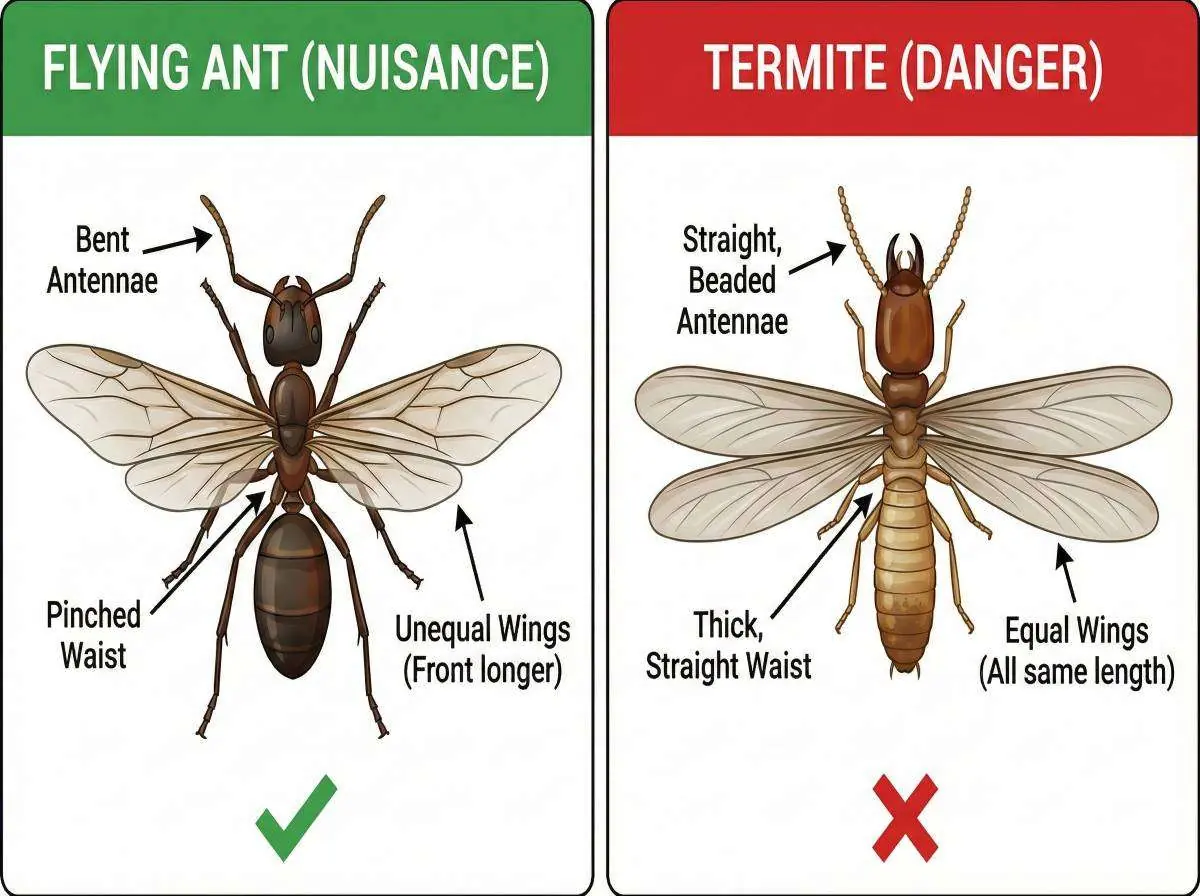
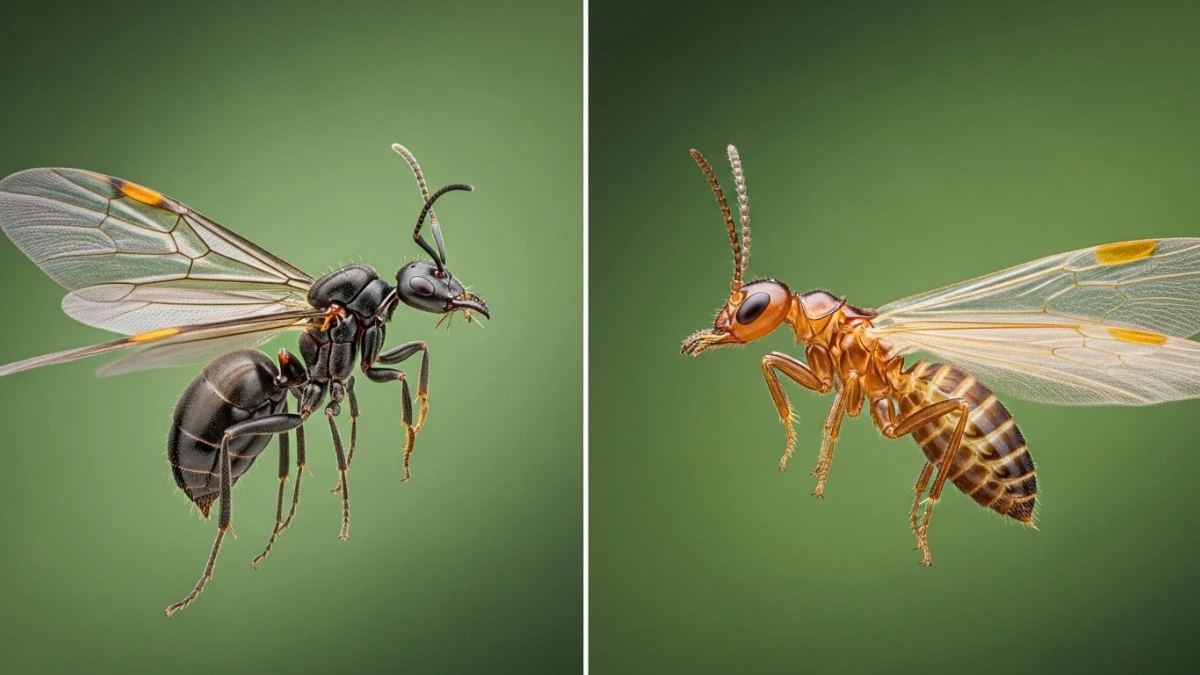
Quick answer: Flying ants have pinched waists, bent (elbowed) antennae, and front wings that are longer than their back wings. Flying termites have thick, straight waists, straight beaded antennae, and four wings of equal length. Flying ants are usually a nuisance you can treat yourself, while flying termites mean a colony may be eating your home’s wood, so book a professional inspection.
Seeing a cloud of winged insects swarm your living room window or crawl across your porch is terrifying. Your immediate thought is likely the worst-case scenario: Is my house being eaten?
But don’t panic yet. While flying termites vs. flying ants look nearly identical to the untrained eye, they are two very different pests with very different consequences for your wallet.
If you are standing there asking yourself, “Ants or termites?”, you need to look closely at three specific body parts: the wings, the waist, and the antennae.
In this guide, we’ll show you exactly how to tell the difference between flying termites and ants with side-by-side photos. By the end of this post, you’ll know if you’re dealing with a simple nuisance you can vacuum up, or a structural threat that requires a professional immediately.
Swarm season: If you live in the South, expect swarms as early as late February or early March. In the North, look for them in April.
* This post contains affiliate links.
How to Tell Flying Termites vs. Flying Ants Apart (With Pictures)
Feature
Flying Ant (Nuisance)
Termite (Danger)
Waist
Pinched (Looks like a wasp)
Thick / Straight (No waistline)
Antennae
Bent (Elbowed shape)
Straight (Beaded shape)
Wings
Unequal Length (Front wings are longer)
Equal Length (All 4 wings same size)
Flying Termites Vs. Flying Ants? When to Call a Professional
Now that you’ve looked at the wings and waist, you likely have a verdict. But knowing what it is is only half the battle. The next step is deciding how to treat it.
The rule of thumb in pest control is simple: Ants are a nuisance; Termites are a structural threat.
Here is your decision guide on whether to DIY or dial a pro:
Scenario A: “I Identified Termites” (The Danger Zone)
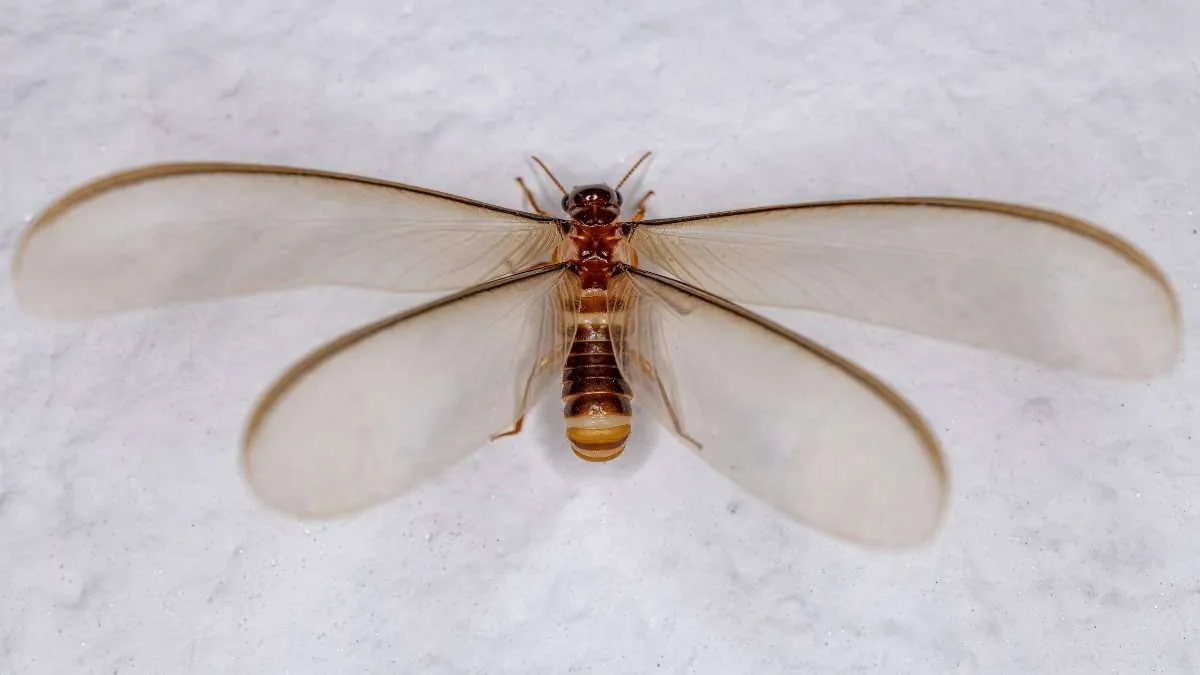
If your swarmer has a thick waist and equal-length wings, you are dealing with termites.
The Risk: Termites eat wood 24/7. By the time you see a swarm in your living room, there is likely a mature colony established nearby that has been active for 3-5 years.
Can I DIY this?No. Termite colonies can extend deep underground or inside wall voids where store-bought sprays cannot reach. Missing even a small pocket of the colony allows them to rebuild immediately.
Recommended Action: You need a professional inspection to determine the extent of the damage. Most major pest control companies offer free initial inspections for homeowners.
Scenario B: “I Identified Flying Ants” (The Nuisance)
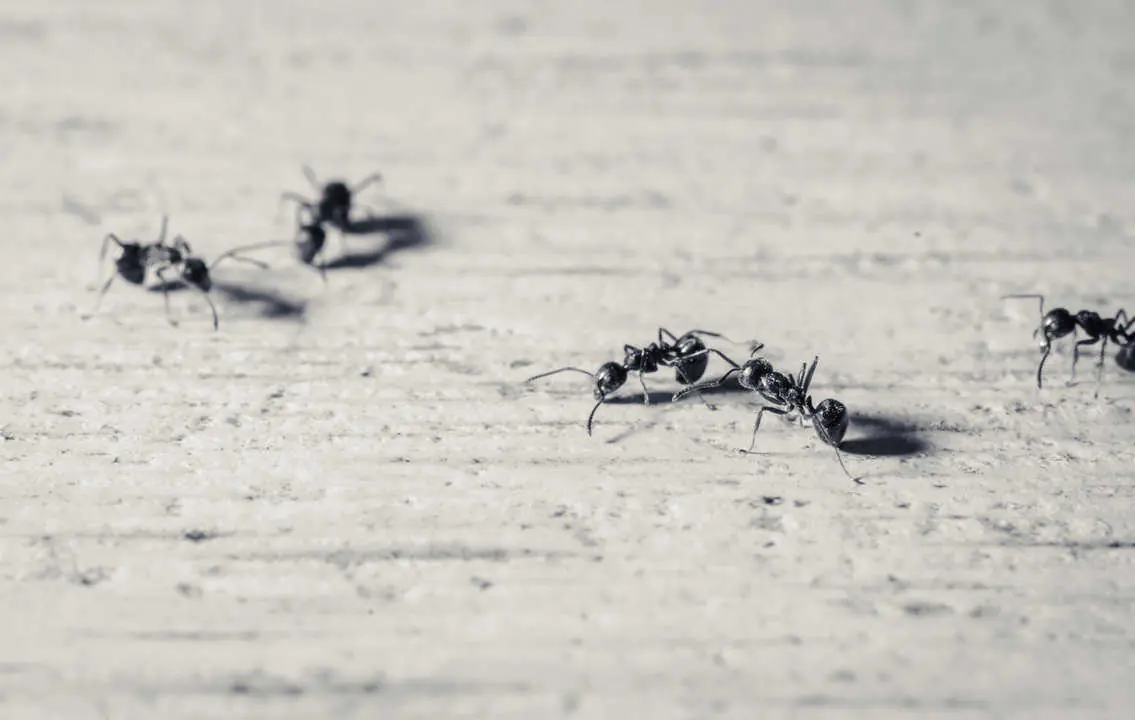
If your swarmer has a pinched waist and bent antennae, you are likely seeing a Carpenter Ant or Citronella Ant reproductive cycle.
The Risk: While Carpenter Ants can damage wood, they do it much slower than termites. They are excavating nests, not eating the wood.
Can I DIY this?Yes. If the infestation is minor, you can often treat it yourself using slow-acting baits that the workers carry back to the queen.
Recommended Action: Locate the source (usually wet wood or a window frame) and apply a non-repellent barrier spray or gel bait.
DIY Ant Control Products That Actually Work
Once flying ants are confirmed, DIY treatments can be effective. The products below target either prevention at entry points or quick elimination of active ant trails indoors.
1. The Mechanical Killer (Best for Prevention)
A chemical-free option designed to stop ants before they enter living spaces by treating cracks, baseboards, and common entry points around the home.
Harris Diatomaceous Earth Food Grade (5 lb)
This is not a chemical—it’s a fossilized algae powder that kills ants by dehydrating them as they crawl across it. It’s completely non-toxic to pets and humans (just avoid inhaling the dust).
Best For: Dusting baseboards, cracks, wall voids, and entry points
Why It Works: It stays effective as long as it’s dry, so every ant that crosses a treated crack or entry point keeps getting hit
2. The Essential Oil Spray (Best for Contact Killing)
Ideal for situations where ants are already visible, this option provides immediate knockdown while also helping disrupt scent trails inside the home.
Wondercide Indoor Pest Control Spray
This plant-based spray uses cedarwood and peppermint oil to kill ants on contact and repel future activity. It smells strong (minty) but is safe to use around kitchens and food prep areas.
Best For: Active ant trails, kitchen counters, and instant swarm control
Why It Works: Kills on contact and disrupts scent trails
Pro Tip: If you continue seeing ants after 7–10 days of DIY treatment, the nest may be hidden inside a wall or under the foundation. At that point, it’s worth getting a professional assessment.
Scenario C: “I Still Can’t Tell” (The Safe Bet)
If you’ve looked at the photos and are still scratching your head—or if you found wings but no bugs—don’t guess. The cost of a professional inspection is usually $0, while the cost of ignoring termites averages $3,000+ in repairs.
If you are unsure, treat it like termites until a professional tells you otherwise.
That's A Wrap
Identifying pests can be tricky, especially when they are swarming in your living room. But when it comes to flying termites vs. flying ants, getting it right matters.
Remember the three golden rules we covered:
Look at the Waist: If it’s pinched like a wasp, it’s an ant. If it’s thick and straight, it’s a termite.
Check the Antennae: Ants have bent (elbowed) antennae; termites have straight (beaded) ones.
Compare the Wings: If the front wings are longer than the back, it’s an ant. If all four wings are the same length, it’s a termite.
If you are 100% sure you are dealing with flying ants, you can likely handle the issue yourself with the products recommended above.
However, if there is even a shadow of a doubt—or if you think you see flying termites—don’t gamble with your home’s structure. The cost of a free professional inspection is zero, but the cost of ignoring a termite infestation can be massive.
When in doubt, call the pros.
Flying Ants vs. Termites: Frequently Asked Questions
Flying ants have a pinched, wasp-like waist, elbowed antennae, and front wings longer than the back wings. Flying termites have a thick, straight waist, straight beaded antennae, and four wings of equal length that extend well past the body.
Winged termites and winged ants look similar at a glance because both swarm in spring and are about the same size. Up close, the termite’s straight waist, straight antennae, and equal-length wings set it apart from an ant.
Flying ants are reproductive ants leaving a mature colony to mate. Seeing them indoors usually means a nest is inside a wall, under the floor, or in damp wood nearby, so look for moisture problems and follow the ant trails back to their source.
Flying termites are worse. A termite swarm indoors usually means an established colony is feeding on your home’s wood, which can cause thousands of dollars in damage. Most flying ants are a nuisance, although carpenter ants can damage wet wood over time.
Collect a few insects or shed wings in a sealed bag, note where you found them, and book a professional termite inspection. Don’t spray the swarm and assume the problem is solved; the colony stays hidden in the wood or soil. Read more about termites with wings.
References & Scientific Sources
For further reading on flying termites vs flying ants their identification methods, and the underlying biology, we relied on the following academic resources:
University of Kentucky Entomology:Termite Control: Answers for Homeowners by Michael F. Potter, Extension Entomologist. (University of Kentucky College of Agriculture).
NC State Extension:Termites vs. Ants by Michael Waldvogel and Patricia Alder. (North Carolina State University).
UC IPM Program:Pest Notes: Termites, Publication 7415. (University of California Agriculture & Natural Resources).
Amos is your go-to editor and pest advice enthusiast, blending years of hands-on experience into clear, practical guidance for everyday pest problems. Growing up on a farm near Grandville, Michigan, he spent his days outdoors, learning to deal with wildlife, pests, and nature in real-world settings rather than just from a textbook. That upbringing turned him into a genuine nature lover, comfortable in fields, woods, and around all the critters that come with them. Today, he channels that background into approachable, science-informed articles that help homeowners protect their spaces without overcomplicating the process. When he’s not polishing guides or answering pest questions, you can imagine him most at home outside—observing animal behavior, walking the land, and turning those observations into practical tips you can actually use. His mission is simple: to give you straightforward, reliable pest pointers so you can spend less time worrying about infestations and more time enjoying your home and yard. Check out my Profile.