Rats are intrusive rodents that occasionally find their way into our homes through small openings, cracked screens, or damaged roofing tiles. If you happen to stumble upon a small pile of their droppings, you may be wondering what to do next.
If you find rat droppings, here’s what you should do next:
Clean the droppings
Identify entry points
Seal all openings
Keep indoor spaces clean
De-clutter the yard
Monitor for future rat activity
I’ll break down each of these essential steps in detail below. This way, the next time you find rat droppings, you’ll know exactly what to do. You’ll learn how to keep these pests from becoming a recurring problem in your home.
* This post contains affiliate links.
Why Rat Droppings Are a Serious Health Concern
First, let’s talk about why rat droppings might be a big deal. Besides being gross and unsanitary, rat feces (along with their urine and saliva) may carry diseases that can be transmitted to humans.
Some of the most concerning illnesses that people can contract from rats include:
Hantavirus Pulmonary Syndrome (HPS) — a potentially fatal respiratory disease
Leptospirosis — a bacterial infection affecting the kidneys and liver
Rat-bite fever — caused by bacteria found in rat saliva and droppings
Salmonellosis — a foodborne illness spread through contaminated surfaces
Of special concern is the Hantavirus, which can be transmitted to people when dried-out rat droppings become airborne and inhaled. Check out our article on Hantavirus from rats to learn more about how this illness is transmitted.
The good news is that not every rat carries diseases, and even if you discover rat droppings, this article will reveal the secret ingredients needed to clean up those pellets safely and effectively!
Important
If you develop flu-like symptoms after contact with rat droppings or nesting material, seek medical attention immediately. Mention possible rodent exposure to your healthcare provider. Early diagnosis dramatically improves outcomes. (Source:Cleveland Clinic, 2026)
What Do Rat Droppings Look Like?
Not all pellet droppings are the same. Rat droppings can be mistaken for several other animals, like mice, squirrels, and voles. Proper identification will not only reveal who is leaving little messes in your home, but also give you a better idea of how to repel these troublesome invaders.
According to NC State University Extension, rats produce between 30 and 50 droppings per day. That’s a lot of poo for such a little critter!
So, what do rat droppings look like?
Size: Pellets are typically ½ to ¾ of an inch long (1.27 to 1.9 cm).
Shape: Rat feces are cylindrical. The ends of the pellets may be rounded or blunted, depending on the rat species.
Color: When fresh, rat droppings are dark brown. As they dry out, they may adopt a dull grey color.
If you’re wondering where you’re most likely to find rat droppings, head over to our article on where rats go during the day to find their secret hiding places.
Rat Droppings vs. Other Rodents
Upon discovering a little unpleasant pile of pellets in your attic or crawlspace, you might be wondering whether it’s from a rat, a mouse, or maybe even a sneaky squirrel or chipmunk.
Here are the major differences in common rodent invaders:
Rodent
Dropping Size
Shape
Rat
0.5 to 0.75 inches (1.27 to 1.9 cm)
Cylindrical, like a large bean with blunted or pointed ends.
Mouse
0.25 inches (0.63 cm)
Grain of rice with pointed ends.
Vole
0.25 inches (0.63 cm)
Cylindrical with rounded ends.
Chipmunk
0.25 to 0.38 inches (0.63 to 0.97 cm)
Teardrop with pointed ends.
Gopher
0.38 inches (0.97 cm)
Pellet with rounded ends.
Squirrel
0.33 to 0.5 (0.84 to 1.27 cm)
Barrel-shaped with rounded ends.
Knowing which critter is leaving behind droppings in your home is the key piece of your pest-control puzzle. It will help you narrow down a pest-specific repellent strategy rather than a broad, generic deterrent.
By the way, if you discover you’re dealing with a mouse instead of a rat, we have some helpful mouse articles that will teach you how to keep these tiny rodents away from your home.
What To Do If You Find Rat Droppings
Here’s where things get interesting. If you find droppings and are sure they are from a rat, there are several important steps to take before even donning a pair of gloves.
First up, let’s talk about some things you shouldn’t do if you discover rat droppings:
Don’t Sweep: sweeping can send particles (potentially virus-carrying particles) into the air.
Don’t vacuum: Similar to sweeping, vacuuming can send particles airborne, where they can easily be inhaled.
Mayo Clinic also supports this; disturbance of dried droppings is the most common cause of Hantavirus exposure in the home.
Now, let’s break down exactly what to do after discovering rat droppings in the home.
Safe Steps To Clean Droppings
Safely cleaning rat droppings involves six steps. Some things you’ll need include rubber gloves, an N95 respirator mask (simple dust masks won’t cut it!), bleach, a spray bottle, and some paper towels or disposable rags.
Here are the six steps to safely and effectively clean rat droppings:
Ventilate the area: air out the area by opening windows and doors and vacating the area for at least 30 minutes.
Put on protection: Don your rubber gloves and mask.
Spray it down: Create a 10% bleach solution and put it in a spray bottle. Spray the droppings thoroughly so they are completely soaked. Let it sit for 10 minutes.
Wipe it up: Use paper towels or disposable rags and wipe up the droppings, making sure to get every single pellet.
Disposal: Place the paper towels or rags in a trash bag and seal the bag. Place that bag in another bag and put it in an outside trash receptacle.
Disinfect the area: Go back to the affected area and use the bleach solution to wipe down everything in the surrounding vicinity.
Unfortunately, finding rat droppings is a sign that there may be active rats inside the home. The good news? We’ve got steps to kick them out and keep them out!
How To Prevent Rat Droppings In The Home
Even if you keep a very clean home, there could be other things that are attracting rats to your property and home. Preventing these scurrying pests from entering the home is the best way to prevent rat droppings in the future.
Below are some eco-friendly ways to keep rats out of the home and yard, including attainable steps that don’t involve harsh chemicals or inhumane practices. These go hand-in-hand with our article on what to do if you find a rat in your house.
Reduce Clutter Inside And Out
Besides food, shelter is one of the top reasons why rats hang around humans. We tend to inadvertently create rat condos when we allow clutter to build up in and around the home.
As a homeowner, it’s totally understandable. There’s that stack of lumber for the next big project, the ever-growing brush pile that needs bagging or burning, and those boxes you swore you’d go through last year…that’s life!
Here are some areas to zero in on when reducing clutter and potential shelter areas for rats:
Wood and brush piles: Stack lumber and firewood off the ground and remove brush piles.
Keep up with yard maintenance: Mow the lawn to keep the grass low, trim overgrown bushes, and don’t allow vegetation to touch the house.
Unused material: Get rid of unused materials that sit in the yard, such as old furniture, rotting lumber, unused pipes, and rusting cars. Put away gardening tools promptly.
Storage spaces: Try to enter storage spaces like unused closets at least once a month, moving boxes around, and otherwise allowing light and movement inside.
Sheds and barns: When possible, keep sheds and barns neat and tidy without storage boxes cluttering up space. If storage boxes must be kept in the shed, store them off the ground. Avoid storing paper materials, as these are used by rats for nesting material.
Cluttered, undisturbed dark spaces are an oasis to rats. Think of areas in your home that are rarely disturbed with plenty of hiding places – that’s where you’ll find the rats! If you’re worried about a cluttered shed, check out our guide on the 7 ways to keep rats out of your shed.
Remove Food Sources
Food is an important resource for pests, especially rats. They like to stay close to their nests when they forage for food. By removing food sources, you’re making it very difficult for rats to establish a home in your space.
Here are some easy ways to make sure you’re not inadvertently leaving out little snacks for rats:
Keep garbage secure: Rats are most active at night, and unsecured garbage cans are like a buffet to these pests! Keep the lids secure with bungee cords or a lid lock. If possible, store the cans in a shed until garbage day.
Bird seed: Believe it or not, bird seed can attract rats (and other rodents). Install bird feeders away from the house and consider a catcher tray to catch falling seed so that it doesn’t end up on the ground as a free snack bar for rats.
Food storage: Store food (including pet food) in hard plastic or metal containers when possible.
Fruit trees: Fallen fruits are very attractive to rats. Try to pick up fallen fruit as soon as possible, and harvest fruit when it is ripe on the branch.
Spills and crumbs: Keep the kitchen as clean as possible, wiping down counters and sweeping the floors to remove any possible crumbs that rats can nibble on.
Without food, rats aren’t likely to stick around. They prefer food sources that are easy to obtain and are in safe areas like inside a shed, garage, or a dark cabinet. Make it difficult for rats to access food by following the above suggestions.
We all know there are openings into our homes, with doors and windows being the most obvious. But rats are sneaky and prefer to get inside using small, unnoticed openings.
Rats can fit through holes as small as ½ inch (1.27 cm). That’s about as small as a AA battery! By sealing up all the gaps and holes around the house, you’re preventing rat droppings from being a recurring issue indoors.
Here are some sneaky openings that rats might use to get inside the house:
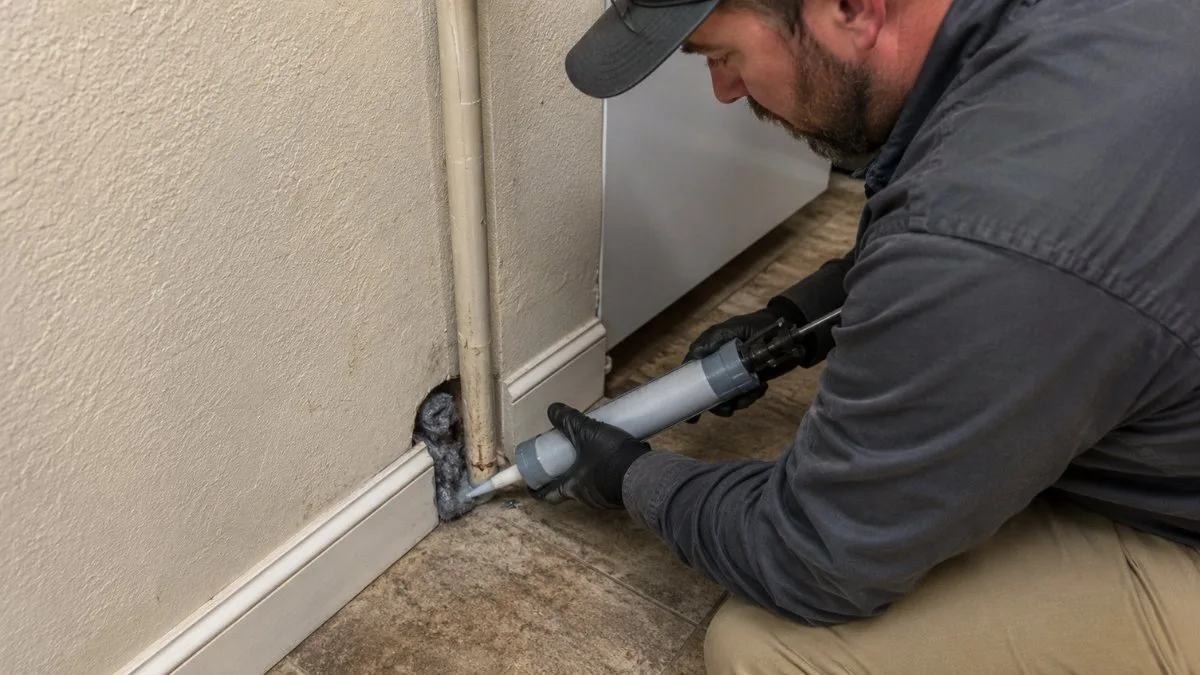
Utility lines: Check where any wiring or water lines run into or out of the home. Over time, these openings may expand, leaving small gaps to the outside.
The fix: Use caulking paired with steel wool to seal openings.
Vents and chimneys: Check dryer vents, chimney vents, and attic vents to make sure they are covered with screening or other material to prevent rats from breaking in.
Damaged roofs: Cracked or loose roofing tiles and eaves offer an easy entry for rats.
The fix: Replace damaged tiles and secure loose ones.
Damaged screens: Check the screens on all the doors and windows to ensure there are no small tears or holes.
The fix: Replace damaged screens.
Gaps in doors: Over time, doorways can warp due to humidity, creating gaps at the bottom of doors. Remember, rats only need a half-inch (1.27 cm) opening to get inside!
The fix: Replace doors with large gaps. Add a door sweep or weather stripping to create a seal.
Sealing entry points is one of the most effective ways to prevent rat droppings from becoming an issue in the house. Combined with reducing clutter and removing food sources, it’s a trifecta of protection against rats, making it extremely difficult for them to establish a nest in or near your home.
Monitor For Rat Activity
Once you’re sure the house is sealed up tight, you’ve de-cluttered the yard, and all food sources are properly stored, it’s time to monitor to make sure there are no more rats.
One of the best ways to do this is by using humane traps. Anyhall’s Rat Traps can be baited with foods high in fat and sugar, such as peanut butter, Nutella, or cheese.
It’s important to note that rats are far more vigilant of their surroundings than mice. It may take up to a week to capture a rat in a trap as opposed to a mouse, which you can usually catch in a day or two.
Leave the rat traps out for at least two weeks, checking daily. If you don’t find any rats, you shouldn’t find any more rat droppings!
Other Signs You Have A Rat Problem (Beyond Droppings)
Rat droppings are the most obvious sign, but they are rarely the only one. Knowing all the signs helps you gauge the severity of the infestation.
Look for these additional indicators:
Grease marks: Rats follow the same paths repeatedly. Their oily fur leaves dark smear marks along walls, baseboards, and pipes. NC State calls these “rat rubs,” and they signal repeated use of a route.
Gnaw marks: Rats chew constantly to keep their teeth filed. Look for bite marks on wood, plastic, pipes, and even electrical wiring. Chewed wiring is a direct fire hazard and should be inspected by an electrician.
Scratching sounds at night: Rats are nocturnal. Rustling, scurrying, or scratching sounds from inside walls, ceilings, or attic spaces at night are a strong indicator.
Musky odor: A persistent ammonia-like or musty smell, especially in enclosed or poorly ventilated spaces, often comes from accumulated urine and droppings. The stronger the smell, the larger the likely infestation.
Nesting material: Shredded paper, insulation, fabric scraps, or cardboard piled in a hidden corner is a nesting site. This is a sign of established activity, not just passing rodents.
When To Call A Pest Control Professional
The steps above work well for minor infestations. For larger problems, professional help is the safer and more reliable option.
Call a pest control specialist if you notice:
Droppings in multiple rooms or areas of the home
Gnaw marks on structural elements or electrical wiring
Strong, persistent musty odor throughout the space
Scratching sounds from inside walls or ceilings
Any daytime rat sightings (signaling a large colony)
Use our pest control finder to locate a licensed professional in your zip code.
That’s All For Now!
Finding a pile of rat droppings is a homeowner’s worst nightmare. These whiskered pests sneak around at night, leaving behind their excrement, oily smudge marks, and musty scent.
If you happen upon a pile of rat droppings while cleaning or moving around storage boxes, here’s a recap of what to do next:
Clean the droppings safely
Identify entry points where rats are sneaking inside
Seal all openings, cracks, and gaps.
Keep indoor spaces clean and crumb-free
De-clutter the yard to avoid providing hiding places
Monitor for future rat activity using humane traps.
If you think you may have a severe infestation on your hands, it might be better to reach out to a professional who can properly assess the situation and utilize professional gear to exclude rats. Otherwise, consider using our tips and control methods discussed here for a rat-free home!
Robyn is your friendly neighborhood writer, editor, and published author - boasting many years of experience in pest control, from which she magically weaves words into the captivating and engaging posts as we know them. When not tucked behind her laptop screen, she can be found embracing nature in the most thrilling ways possible. Rock climbing? Yes, please! Hiking? Absolutely! Traveling the U.S. with her husband, their lovable three-legged dog, and two mischievous cats? That’s her everyday reality. They live, love, and work in their cozy campervan, letting the road take them where it will, and finding inspiration in every sunrise, mountain peak, and wildlife sighting they encounter. Check out my Profile.
Pest Pointers was started in a cozy corner of Upstate New York, known for its expansive pastures, dense woods, and abundant wildlife pests. We are dedicated to providing YOU with solutions and insights into managing common pest issues. Starting out on over 50 acres of land and a freshwater bass pond with abundant pests, we combine firsthand experience with dedicated advice to help you tackle even the toughest of critters!