Squirrels are adorable, funny, and playful, but they can also be major pests. And since there are more than 200 species of squirrels on a mission to collect all the food they can before winter, it’s likely that you’ll have some sort of run-in with them.
You can use loud noises to keep squirrels away from your home. Sounds from humans, such as loud laughter, yelling, and noisy conversations will scare them. High-volume music and the sound of predatory birds can also startle squirrels, causing them to stay away.
Read on for some information about where squirrels prefer to live as well as 4 sounds that’ll scare squirrels away from your gardens and bird feeders. Hint: if you have a loud family, you’re in luck!
* This post contains affiliate links.
Places Where Can Squirrels Be Found
If you’ve ever watched hilarious squirrel videos online or spent any time snacking on popcorn in a park, you’ll know that squirrels are pretty comfortable around us humans! In fact, you can find squirrels in most urban or suburban areas that have large trees, whether it be in a backyard or a park.
As you probably already know, squirrels love to climb trees! They especially love hardwood trees. Their favorite varieties are:
Oak
Hickory
Pine
Spruce
Balsam Fir
Home Preference Varies By Squirrel Species
Male and female squirrels look identical, but you can definitely tell the difference between species.
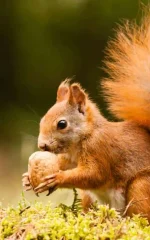
Gray squirrels are grizzled or light gray with white on their underside, while red squirrels are a shade of red with white or gray on their undersides. Red squirrels are slightly smaller than their gray kin.
Gray squirrels have their babies between March and April and again from June until August, depending on how abundant their food supplies are. Red squirrels typically just have one litter between March and May.
Squirrels will raise their litters in numerous places.
For instance, gray squirrels prefer to use live hard tree cavities to care for their kiddos, but they will also make leafy nests (called a drey) if they have to.
Red squirrels, on the other hand, will make use of rock dens or burrows if necessary.
When they’re born, baby squirrels are hairless, pink, and look a lot like other young mammals. Fun fact – you can note the kit is a squirrel by its dark toenails!
By the time they turn the ripe old age of 12 weeks, the babies head out into the big wide world to make their fortunes (of acorns and nuts, of course!)
Do not offer any food or water if you come across a baby squirrel that has fallen out of her nest. Instead, set a shoebox filled with leaves and other nesting materials under a tree so that mama can easily cart the babe back up to her nest. (Just be sure to leave the area, otherwise, she might not be rounded up to rejoin her siblings.)
Squirrels Are Active Based On Their Foraging Habits
Depending on the species of squirrel, they’re active at the best time for collecting their preferred foods.
Gray squirrels are diurnal and prefer the dawn or dusk hours. Red squirrels prefer to collect their nutty bounty during the day, provided the heat doesn’t become too much for them.
Squirrels all have one super cool thing in common: their teeth grow continuously and need to be filed down. They do this in nature by eating things with rough surfaces, like acorns and nuts.
Squirrels like to live where their preferred foods are. For instance, gray squirrels prefer to dine on the following meals:
Oak acorns
Hickory nuts
Beechnuts
Walnuts
Berries
Fruits
Seeds
Buds
Flowers
Cultivated grains
Red squirrels also have a diverse diet, but they prefer:
Conifer seeds
Fungi
Flower buds
Inner bark of trees
Nuts
Seeds
Fruits
Grains
Insect Larvae
Bird nestlings
Squirrels are known as scatter hoarders. Scatter hoarders collect food en masse when it’s abundant and flourishing. They take it all over the area and store it in thousands of places for future meals, according to Bioscene.
These storage centers come in handy during the colder months. Since squirrels don’t hibernate, they make use of their caches by venturing out on sunnier days to find their food and do some binge eating. (This sounds remarkably similar to what we humans tend to do when it’s cold!)
Some studies have shown that squirrels have a behavioral trait called flight initiation distance which is a measurement of how close we can get to our animal friends before they run away. Below are some other things that scare squirrels away.
Human Noises (Sometimes) Scare Squirrels Away
While squirrels tend to run away when humans come close, sometimes they’re just too used to us. Because they know that we aren’t really a big threat, squirrels won’t go too far when we are near.
In fact, squirrels who are regularly around humans have less of the flight initiation distance mentioned above.
Researchers think that they adjust their antipredator behavior since humans do not tend to act as typical predators toward them.
Even in public parks, these researchers found that squirrels’ flight distance was related to how busy the park is. Squirrels in busy parks where humans constantly passed by them came closer to humans.
Squirrels in less busy parks tended to stay away since they didn’t regularly interact with us and perceived humans as more of a threat.
Squirrels hate Loud Music
Like a lot of us, squirrels might not be fans of loud headbangers. Loud music being played from outdoor speakers can help keep squirrels at a distance.
One study showed that playing loud music made squirrels flee an average of over 22 feet away, which is an increase of more than 9 feet from the group that did not have music playing.
While loud music isn’t a permanent solution (your neighbors may be inclined to cut the power cord), playing music at a decent volume during the day can keep the squirrels away. Outdoor speakers like these Polk Audio Atrium 4 Outdoor Speakers which can help you blast some tunes when the squirrely nutters get too close to home.
Squirrels Listen to Birdsong
It turns out humans aren’t the only ones who like to listen to the birds sing! Interestingly, squirrels listen to what’s going on around them in the forest, particularly when it comes to what the birds are gossiping about.
Bird chatter can let the squirrels know whether the area is safe or if there’s something to worry about.
When squirrels hear normal song patterns, they tend to take that as having some degree of safety. However, when one group of researchers (published in PLoS One) played the sounds of a red-tailed hawk, squirrels became more vigilant and wary of their surroundings.
This indicates that squirrels paid a lot of attention to what kind of birds were around, and perceived a greater threat when they heard the predator bird chattering away.
The sound of any large predatory bird can be used to help scare squirrels away. Using something like the BUBOBOSS Fake Scarecrow Owl Decoy can help by employing their motion-activated sounds and movements to safely scatter the squirrels.
While squirrels can become comfortable being around humans, they do happen to be scared off by humans making loud noises.
When we laugh boisterously with our friends or have a heated and loud argument with our mother-in-law, squirrels can be too intimidated to come too close to humans.
Some species of squirrel can even remember people’s faces! Researchers call this discrimination, and they say that it often happens when squirrels recognize a particular person who has been a nuisance to them in the past.
While sounds can work, hot pepper or vinegar are much better squirrel repellent in their own right.
Tips for Dealing With Trouble Squirrels
Anyone with a bird feeder knows that squirrels can be troublesome little buggers. And if you also keep a garden, the rascals are double trouble!
With their love of food and adaptability toward humans, squirrels can cause loads of problems in our backyards.
Now that we know more about our backyard pals, it’s time to talk about how to keep them away from our homes.
Squirrels Love To Graze In Our Gardens
Frequently, squirrels think of our gardens and orchards as their own private buffets. When troublesome squirrels come to your place uninvited, the best way to deter them is to keep a protective barrier around the plants when they’re just starting to grow.
Once the plants get a little larger, squirrels tend to become disinterested in the results of your hard work.
Bonus: they keep away the bunnies and birds too, so you’re not feeding the whole neighborhood!
Squirrels Can Make Themselves At Home In OUR Houses
Sometimes squirrels can even make themselves comfortable in our homes! They love the nice warmth of our insulation, and can stick around for a while. Insulation also makes perfect nesting material, so they love to take some back to use in their own nests.
And since, like all rodents, their teeth never stop growing, things like electrical wires and cords are very attractive to these chewing rodents. This can cause some major home problems!
To help prevent them from coming into the house, check for any open areas that they may want to enter, like crawl spaces or attics. Use ½ inch wire mesh or hardware cloth to cover any of those spaces securely.
GoldPeak Black Hardware Cloth Vinyl Coated Wire Mesh is a good choice for blocking out unwanted visitors. In addition to the vinyl coating, it’s also galvanized inside, providing a double coating to prevent rust!
If there are trees close to your home, take some time to trim back the branches. Branches should be no closer than 6 to 8 feet from the home, because squirrels make basketball dunks look like nothing!
Be sure to hire a professional if your tree is very large and unruly. If your branches are manageable, safely using a pole saw can help cut everything back in no time.
This 14-foot cordless V20 from Craftsman is easy to use with its extended reach and cordless accessibility. With a high-capacity battery pack and angled head and blade, this tool can really help keep the branches back and the squirrels where they belong: out of your home!
Squirrels Go Nuts for Nuts (And Seeds)
If you are a fan of bird feeders, you know that nothing excites a hungry squirrel like a good seed mix.
To keep your seeds where they belong (for the birds), make sure the areas around your bird feeders are clean.
Where squirrels are attracted, so are large predators, so keeping things tidy can save you a whole lot of trouble in the long run.
Since squirrels have a tendency to jump, climb, dangle, and battle their way into a bird feeder, choosing one that will keep them out can be a challenge. There are squirrel guards that can be added to your feeders as well as feeders that are designed just to keep them out.
The Roamwild Squirrel Proof Wild Bird Feeder, with a weight-activated door that blocks off the food, is a great option. Squirrels learn quickly that their advances are futile, leaving the dining to the downy woodpeckers.
That’s A Wrap!
Even though squirrels are adorable to look at and can provide hours of entertainment, having them around your home can cause loads of trouble.
While they may be used to humans, loud noises like laughter and music can make them think twice. And using a decoy of a predatory bird (like an owl or hawk) with noise can make them scurry back into their nests.
Be sure to keep your home protected too. Cover any openings you might find and trim back your tree limbs so the little suckers can’t kamikaze their way onto your roof.
Use these noises and tricks to help keep the squirrels away and then take a walk in the woods and enjoy them in their own environment.
Cooper, C. A., Neff, A. J., Poon, D. P., & Smith, G. R. (2008). Behavioral responses of eastern gray squirrels in suburban habitats differing in human activity levels. Northeastern Naturalist, 15(4), 619-625.
Darling, R. A., Smith, A., & Mello, A. (2021, December). A field project: Investigating the influence of urban noise on eastern gray squirrel behavior. Bioscene: Journal of College Biology Teaching, 47(2).
Engelhardt, S. C. & Weladji, R. B. (2011) Effects of levels of human exposure on flight initiation distance and distance to refuge in foraging eastern gray squirrels (Sciurus carolinensis). Canadian Journal of Zoology, 89(9), 823-830.
Lilly, M. V., Lucore, E. C., & Tarvin, K. A. (2019). Eavesdropping grey [sic] squirrels infer safety from bird chatter. PLOS One, 14(9). DOI:10.1371/journal.pone.0221279
Radermacher, E. (2018). Responses of urban gray squirrels (Scurius carolinensis) to humans and conspecifics in an area of Boston Common. WR: The Journal of the CAS Writing Program, 11(2018-1019).
Robyn is your friendly neighborhood writer, editor, and published author - boasting many years of experience in pest control, from which she magically weaves words into the captivating and engaging posts as we know them. When not tucked behind her laptop screen, she can be found embracing nature in the most thrilling ways possible. Rock climbing? Yes, please! Hiking? Absolutely! Traveling the U.S. with her husband, their lovable three-legged dog, and two mischievous cats? That’s her everyday reality. They live, love, and work in their cozy campervan, letting the road take them where it will, and finding inspiration in every sunrise, mountain peak, and wildlife sighting they encounter. Check out my Profile.
2 Comments
Forgot a question, has anyone used an air horn to scare squirrels away. Sure, neighbors would not like it. The water squirter, they out smart it. I’ve trimmed all my trees, tried spikes on the fence, but they now know how to use the fence to get around them. If only people stopped feeling them, they are rodents just like rats and mice. They can do as much damage to your home (electrical wires, etc.) as a rat can, maybe more. One friend had one eat a hole through her siding on the third floor of her condo, then ate insulation (to make a trail), and started eating through her bedroom ceiling. She wasn’t happy with her findings. These aren’t cute friendly pets. Oh, cute to watch from a distance while they have their zoomies. Just not cute in how they destroy gardens, cars, homes, etc. They have taken down power to several buildings, yes, by “Oops, well that was a live wire.” One way of getting rid of them. Joking.
Thank you for not stating the ones that don’t work, like chili peppers, garlic, and those types of things that lose their smell quickly or rinse away. I’ve at my wits-end with squirrels. They use every fence around me to make their highways. Problem in our area is those who think it good to feed squirrels. They are not pets. For my pots, I’ve put straw, pebbles (they work the best), squirrel rid products, rocks, chicken wire, other fence wire. And as soon as there is one little spot open, they dig away. I now use wire, rocks, and blood meal. But be careful of using too much blood meal. They don’t like the smell and stay away; however, it too doesn’t last long. Can’t see getting an exterminator or someone to remove them. They need to be taken away at least 30 miles. When you relocate, new critters move in. At least for spring and summer, the best method is my Westie. The squirrels have us trained for the run!
Pest Pointers was started in a cozy corner of Upstate New York, known for its expansive pastures, dense woods, and abundant wildlife pests. We are dedicated to providing YOU with solutions and insights into managing common pest issues. Starting out on over 50 acres of land and a freshwater bass pond with abundant pests, we combine firsthand experience with dedicated advice to help you tackle even the toughest of critters!




2 Comments
Forgot a question, has anyone used an air horn to scare squirrels away. Sure, neighbors would not like it. The water squirter, they out smart it. I’ve trimmed all my trees, tried spikes on the fence, but they now know how to use the fence to get around them. If only people stopped feeling them, they are rodents just like rats and mice. They can do as much damage to your home (electrical wires, etc.) as a rat can, maybe more. One friend had one eat a hole through her siding on the third floor of her condo, then ate insulation (to make a trail), and started eating through her bedroom ceiling. She wasn’t happy with her findings. These aren’t cute friendly pets. Oh, cute to watch from a distance while they have their zoomies. Just not cute in how they destroy gardens, cars, homes, etc. They have taken down power to several buildings, yes, by “Oops, well that was a live wire.” One way of getting rid of them. Joking.
Thank you for not stating the ones that don’t work, like chili peppers, garlic, and those types of things that lose their smell quickly or rinse away. I’ve at my wits-end with squirrels. They use every fence around me to make their highways. Problem in our area is those who think it good to feed squirrels. They are not pets. For my pots, I’ve put straw, pebbles (they work the best), squirrel rid products, rocks, chicken wire, other fence wire. And as soon as there is one little spot open, they dig away. I now use wire, rocks, and blood meal. But be careful of using too much blood meal. They don’t like the smell and stay away; however, it too doesn’t last long. Can’t see getting an exterminator or someone to remove them. They need to be taken away at least 30 miles. When you relocate, new critters move in. At least for spring and summer, the best method is my Westie. The squirrels have us trained for the run!